Four years into its full-scale war in Ukraine, Russia is feeling the effects
February 23, 2026 at 06:01 AM
By BBC News - World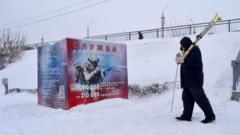
Steve Rosenberg reports on the economic consequences of Russia's war, and how people are coping.
💡Analysis & Context
Steve Rosenberg reports on the economic consequences of Russia's war, and how people are coping Steve Rosenberg reports on the economic consequences of Russia's war, and how people are coping. Monitor developments in Four for further updates.
📋 Quick Summary
Steve Rosenberg reports on the economic consequences of Russia's war, and how people are coping Four
Steve Rosenberg reports on the economic consequences of Russia's war, and how people are coping.
Four years into its full-scale war in Ukraine, Russia is feeling the effects21 minutes agoShareSaveSteve RosenbergRussia editor, in LipetskShareSaveBBCPosters offering large sums of money for joining the army are everywhere in RussiaAt first glance, Yelets in winter looks like something from a Russian fairy tale.From the embankment I spy the golden domes of Orthodox churches and, down below, ice fishermen dotted along the frozen river.But in this town, 350km (217 miles) south of Moscow, the fairy tale feeling is transient.On the riverbank I spot an army recruitment billboard. It promises a one-off sum equivalent to £15,000 to anyone who'll sign up to fight in Ukraine.Close by there's a poster of a Russian soldier taking aim with a Kalashnikov."We're there where we need to be," the accompanying slogan declares.The Kremlin launched its full-scale invasion of Ukraine on 24 February 2022. Outside Russia it was widely seen as an attempt to force Kyiv back into Moscow's orbit and to overturn the entire post-Cold War security architecture in Europe.The Russian leadership envisaged a short and successful military operation.It didn't go to plan.Four years later, Russia's war on Ukraine grinds on. It has lasted longer than Nazi Germany's brutal war on the Soviet Union, known here as the Great Patriotic War.And, in this town, you can see some of the consequences.A giant mural fills one side of a nine-storey Yelets apartment block. Depicted here are the faces of five Russian soldiers, local men killed fighting in Ukraine."Glory to the heroes of Russia!" has been painted at the top.The Russian authorities do not release casualty figures for the so-called "special military operation". But Russia is known to have suffered huge battlefield losses. So many of the towns and villages I've visited in the last two years have had museums and monuments dedicated to soldiers killed in Ukraine, as well as separate sections for recent war dead at local cemeteries."My friend's husband was killed fighting there. The son of my cousin, too. And grandson," says Irina, who has stopped to chat to me opposite the mural."Lots of people have been killed. I feel sorry for these lads."Irina is a ticket collector at the bus station. She struggles to make ends meet."Utility bills are suffocating us. Prices are crushing us. It's very hard to get by."Although money is tight, Irina helps put together aid packages for Russian soldiers on the front line. She doesn't criticise the war on Ukraine. She is, though, confused by it."In the Great Patriotic war, we knew what we were fighting for," Irina says. "I'm not sure what we're fighting for now."The border with Ukraine is 250km away. But sometimes the front line feels much closer. This part of Russia, Lipetsk region, like many others, has been targeted by Ukrainian drones. Around Yelets the authorities have installed emergency shelters. I spot one at a bus stop, another in a park.These concrete constructions stand like monuments to President Vladimir Putin's "special military operation". Before the Kremlin's full-scale invasion of Ukraine there had been no need for shelters, since there had been no drone attacks on Russia.Blocks of flats in Yelets have designated shelters, too, in basements."The sirens go off almost every night," Irina explains. "But I don't leave my building. We just go into the corridor where there are no windows."Before Russia's full-scale invasion of Ukraine, shelters like these didn't exist in RussiaIn Yelets you'll find signs of war in unlikely places. I notice that the name of a local pancake cafe features the Latin letters V and Z – symbols of the "special military operation".The sign outside adds: "Grab a pancake, then the whole world."I'm taken aback. Then I recall some of the things Vladimir Putin has said."Where the foot of a Russian soldier steps, that's ours," he declared in St Petersburg last year.Two years ago in Moscow I saw an electronic billboard displaying this Putin quote: "Russia's borders do not end anywhere."Wars are financially draining. With Russia's budget deficit growing and the economy stagnating, the government has raised VAT from 20% to 22%. The Finance Ministry says the extra revenue will be spent on "defence and security."Read more on four years of full-scale war in Ukraine:The Russian village of Sedanka that lost its men to warFood prices surge: Is the war hitting Russians in the pocket?Tracking the war in mapsRussian state TV has encouraged the public to be understanding."We live in a time of war: a war forced on us by the West," TV anchor Dmitry Kiselev told viewers. "We have to win it, and we can't get by without a war budget."Small businesses are feeling the pinch. In a Yelets bakery the smell of freshly baked raisin bread, scones and cream pastries is intoxicating. But the shop has been hit by Russia's economic downturn and t
Share:
Original Source:
Read full article at sourceHelp us improve this article. Share your feedback and suggestions.